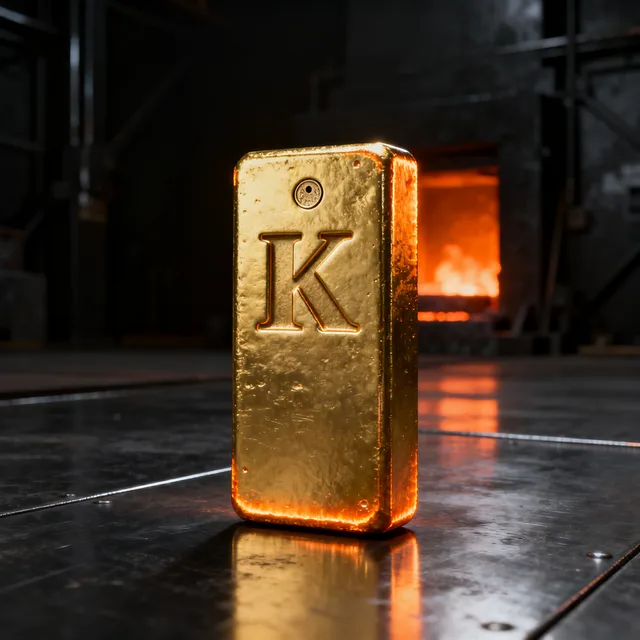
How Karat works
Karat is a mint on top of Pons. Every coin cast through it is quoted in gold instead of ETH, and carries a bar: a contract that keeps a fixed share of the coin's fees as a gold reserve its holders can melt out.
What it is
Pons lets a coin launch against a pair token other than ETH. Karat always picks GLD, the token of SPDR Gold Trust on Robinhood Chain. The coin is bought with GLD, its bonding curve holds GLD, and the creator fee Pons collects on every trade arrives in GLD.
The fee recipient of every Karat coin is not a person. It is the coin's bar, a small contract created at casting. The bar splits what arrives by a rule fixed at casting and keeps its share as a reserve that belongs, pro rata, to every coin in existence.
Why GLD
GLD is one of the Robinhood stock tokens. On the day Karat was built it traded in eight pools on the chain, the deepest being Uniswap V3 GLD/USDG at 0.3%. Karat prices GLD in dollars from that pool's own price, with no oracle. Everything else on the site is shown in GLD.
GLD tracks a share of a gold trust. It is not an ounce of metal and it is not redeemable for bullion through Karat.
Casting
cast(name, symbol, logo, description, taxBps, fineness) on the mint does four things in one transaction: it creates the bar, launches the coin on Pons with GLD as the pair and the bar as the fee recipient, binds the bar to the coin, and records the strike with a serial number. The only ETH involved is the Pons launch fee, which goes straight to Pons.
The hallmark
A hallmark on metal states how many parts per thousand are pure gold. On Karat it states how many parts per thousand of every fee stay in the bar. The remainder is the creator's, less one fifth for the refinery.
| hallmark | stays in the bar | creator | refinery |
|---|---|---|---|
| 375 | 37.5% | 50.00% | 12.50% |
| 585 | 58.5% | 33.20% | 8.30% |
| 750 | 75.0% | 20.00% | 5.00% |
| 916 | 91.6% | 6.72% | 1.68% |
| 999 | 99.9% | 0.08% | 0.02% |
The hallmark is written once, when the bar is created, and there is no function that changes it.
Assay
assay() on a bar can be called by anyone. It sweeps the curve's accrued tax, claims what the Pons escrow holds for the bar, and splits whatever gold arrived since the last assay. The creator and the refinery are paid in GLD in the same call. Coins of the bar that arrive as fees are burned.
A bar that receives GLD from anywhere else, a donation for example, treats it exactly like a fee.
Melt
melt(coins, minGold) sends your coins to the dead address and pays
gold = reserve × coins / liveSupply liveSupply = totalSupply − balanceOf(dead)
Both sides of that ratio move only when coins are burned. Coins sitting in the bonding curve, in a pool or in any other contract still count as live, so selling, lending or parking coins cannot raise anyone's share. This was checked on the fork: a sale into the curve and a transfer to a third contract left the value per coin unchanged to the wei, and a burn raised it.
The consequence is a conservative floor. Early on most of the supply still sits unsold in the curve, so the bar's value per coin is small next to the curve price. It grows with every fee and every burn. The site shows both numbers side by side and never calls the bar's value a price.
The casting block
Pons charges a launch tax on buys made in the same block a coin is launched. On a coin cast through Karat that tax lands in the bar. Measured on a fork of Robinhood Chain mainnet on 2026-09-21, with a 3% creator tax and a 999 hallmark:
These are Pons' rules, not Karat's, and Pons can change them. Karat only decides where the creator's side of them goes.
Refinery
The refinery is the treasury. It holds GLD and can do one thing with it: buy $KARAT and send it to the dead address, at most a fifth of its gold per call, with a minimum set by the caller. If $KARAT is itself quoted in gold the purchase is made in GLD directly, on the curve or in the Uniswap v4 pool after graduation. If $KARAT is an ETH launch, GLD is first sold for ETH through one Uniswap V3 pool recorded once. There is no withdraw function.
Contracts
The mint has a guardian. The only thing the guardian can do is propose a new refinery address, which takes effect after 48 hours and which anyone can then activate. Bars read the refinery address from the mint at each assay, so the notice period covers every bar. The guardian cannot touch a reserve, a hallmark or a creator.
The test suite runs against a fork of Robinhood Chain mainnet with the real Pons factory, curve and escrow and the real GLD pools: 106 checks, among them the split for each hallmark, melt arithmetic to the wei, the manipulation checks above, both refinery routes and the guardian's limits.
$KARAT
$KARAT is the mint's own coin. It has no rights over the mint or over any bar. One fifth of the non-reserve share of every fee on every coin goes to the refinery, and the refinery can only spend it on burning $KARAT.
Risks
- A coin can trade far above the value of its bar and fall back to it. The bar is a floor in gold, not a promise about price.
- GLD is a token issued by a third party. If it stops trading or loses its peg to the trust, every reserve loses value with it.
- Karat depends on Pons: the factory, the curve and the escrow are Pons contracts. Pons is not verified on the explorer; the escrow's token functions were read from its bytecode.
- The contracts have been tested on a fork, not audited by a third party.
FAQ
Can the creator take the reserve?
No. The bar has no owner, and its only function that pays out of the reserve is melt, which pays the caller their own share.
Why is the bar's value per coin so small at first?
Because it is counted against every coin that exists, including the unsold ones in the curve. That is what makes it impossible to game.
What does a 999 coin give its creator?
Eight hundredths of a percent of the fees. It is a coin that keeps its gold.
Do I need ETH?
For gas, and for the Pons launch fee when casting. Trading and melting are in GLD.